
Pro Breeze
OmniAir 5L Evaporative Air Cooler & Portable Tower Fan With Humidification Modes
Evaporative
Free delivery · 2–3 working days
£199.99
● In stockAn evaporative air cooler draws warm room air through a wet honeycomb pad, and as the water evaporates it pulls heat from the air, blowing out a cooler, slightly more humid breeze. Often called swamp coolers, they sit between a fan and an air conditioner: more cooling than a fan, far cheaper to run than refrigerant air con, and with zero installation. Our range spans portable air coolers from Symphony, Honeywell, Pro Breeze and MasterKool iKool, all with free UK delivery.
This is the make-or-break question, so we'll be straight with you. Evaporative cooling works best in hot, dry air. The drier the air, the more water can evaporate and the bigger the temperature drop. The catch is that British weather is often humid, and once relative humidity climbs above roughly 60–70% the effect shrinks noticeably. On a muggy, overcast day you may feel little more than a moving breeze. On a genuinely hot, dry spell, or in a kitchen, conservatory, garage, workshop or home office where the air is warm and stale, a cooler earns its keep. If you need guaranteed temperature control in any weather, a portable air conditioner is the honest answer, and our air cooler vs portable air conditioner guide breaks down the trade-offs.
The big advantage is energy use. A typical air cooler draws around 60–90 watts on full power, similar to a pedestal fan. At the current price cap of about 26p per kWh, running a 75W cooler costs under 2p an hour, versus 25–40p an hour for a portable AC. There's no refrigerant, no exhaust hose and no window kit.
When choosing, weigh the water tank capacity (larger tanks, often 5–10 litres, run longer between top-ups), airflow in CFM, oscillation, a remote control and timer, and an ice-pack compartment, since adding ice or chilled packs gives a short-lived extra chill. Use it with a window cracked open to let humid air escape, which keeps the cooling effective.
18 products

 Out of stock
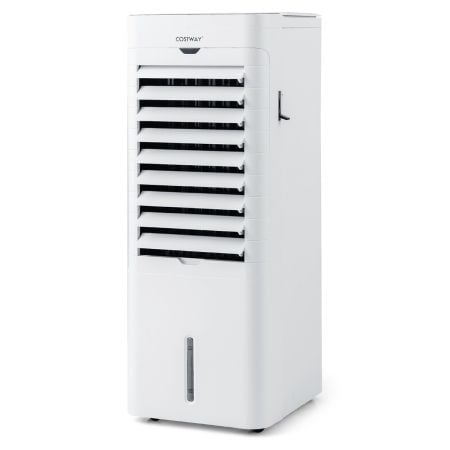
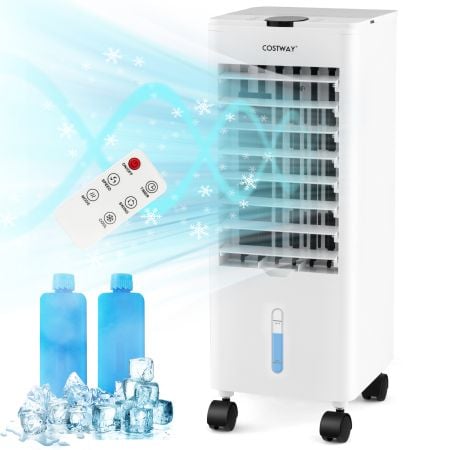
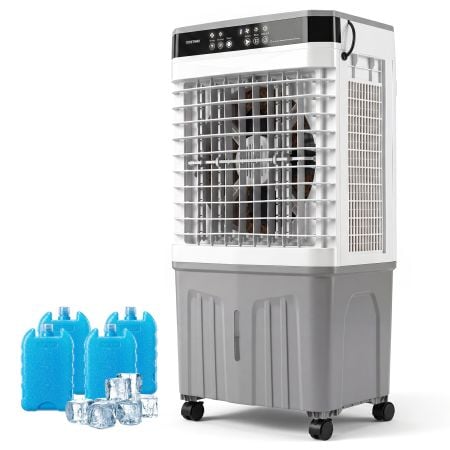 Out of stock
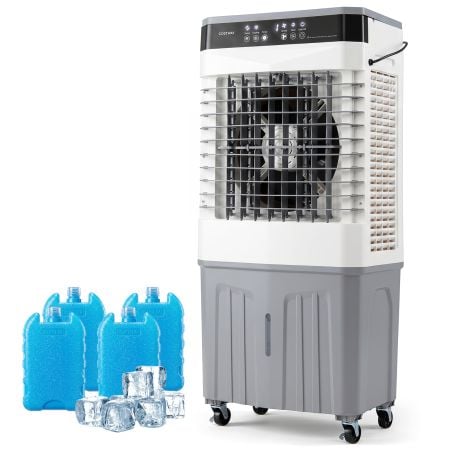 Out of stock
 Out of stock
1. Match it to your climate and room. Coolers shine in warm, dry, well-ventilated spaces, kitchens, conservatories, garages and workshops. In a sealed, humid room the effect is muted, so keep a window ajar.
2. Check the water tank. A 5–10 litre tank means fewer refills and longer unattended running. Smaller desk coolers need topping up more often.
3. Look at airflow and coverage. Higher CFM moves more air. Coolers cool the space immediately around them rather than a whole house, so size the unit to where you sit.
4. Prioritise the right features. Oscillation spreads the breeze, a timer suits bedrooms, and an ice-pack compartment gives an extra short-term chill on hot days.
5. Mind the running cost. Most draw 60–90W, costing under 2p an hour at ~26p/kWh, a fraction of a portable air conditioner.
They can, but with caveats. Evaporative coolers rely on dry air to work well, so they perform best during hot, dry spells and in warm, stale rooms like kitchens, conservatories, garages and workshops. On humid, muggy British days the cooling effect is much weaker. Keeping a window slightly open helps by letting humid air escape.
Not very well. The cooling comes from water evaporating into the air, and humid air already holds a lot of moisture, so less can evaporate. Once relative humidity rises above around 60–70%, the temperature drop becomes small and you'll mostly feel a moving breeze rather than genuine cooling. In persistently humid conditions, a portable air conditioner is more reliable.
They're worth it for the right job. As a low-energy, refrigerant-free, no-installation way to take the edge off the heat in a warm, dry, ventilated space, they're excellent value and far cheaper to run than air con. They are not a substitute for an air conditioner if you need guaranteed temperature control in any weather. Set expectations correctly and most buyers are happy.
Very little. Most evaporative air coolers draw around 60–90 watts on full power, similar to a pedestal fan. At roughly 26p per kWh, a 75W cooler costs under 2p an hour to run. By comparison, a portable air conditioner typically costs 25–40p an hour, so a cooler is a fraction of the price.
Yes, most models include an ice-pack compartment or a tray for ice cubes or chilled packs. Adding ice lowers the temperature of the water, giving a short-lived extra chill to the air being blown out. The effect is modest and temporary, lasting until the ice melts, so it's a nice bonus rather than the main cooling mechanism.
An air cooler evaporates water to cool the air, uses very little electricity, needs no installation and no exhaust hose, but its performance depends on how dry the air is. An air conditioner uses a refrigerant cycle to actively remove heat, works in any humidity and gives precise temperature control, but costs far more to buy and run and usually needs a window vent. Coolers add a little humidity; air conditioners remove it.
Air coolers are best thought of as personal or zone coolers. They cool the area immediately around the unit rather than uniformly chilling an entire room the way an air conditioner can. For best results, position the cooler near where you sit, keep a window cracked for ventilation, and choose a higher-airflow model for larger spaces.
Yes, this is their standout strength. With typical power draw of just 60–90 watts, they use a fraction of the electricity of a refrigerant-based air conditioner, which can pull 800–1,200 watts or more. There's no compressor and no refrigerant, so running costs stay low at under 2p an hour for most units. They're one of the cheapest ways to cool a warm room.